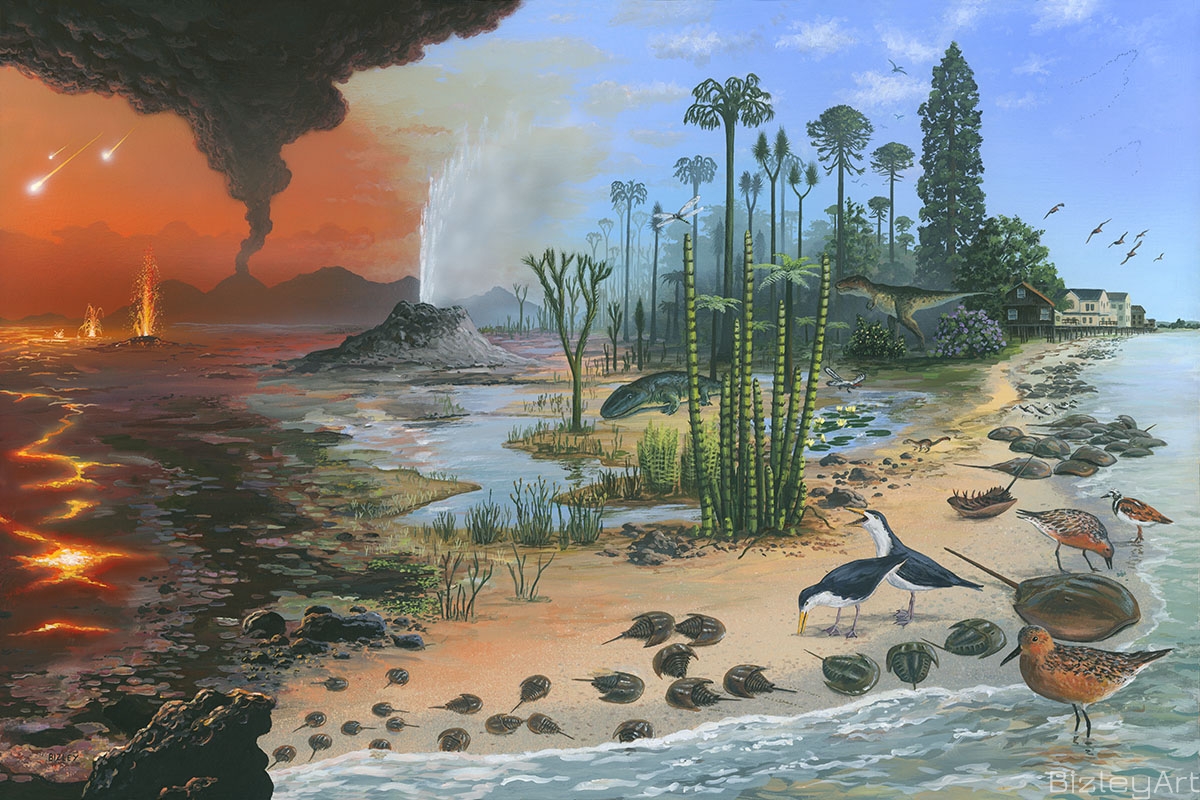
1803 Horseshoe Crabs Through the Ages
Horseshoe Crabs through the Ages
This painting spans from the PreCambrian to the Present, approx 4600 million years, splitting into six unequal columns.
Left to right:
PreCambrian
Ordovician
Devonian
Carboniferous
Cretaceous
Present
Please note, there is some overlap with other periods in order for the landscape to flow coherently. Here’s a rough explanation of the image:
PreCambrian
The environment of early Earth was vastly different to the present. It was a molten ball with a very thin crust of solid rock. Over eons Earth cooled and life emerged, possibly in the hydrothermal vents in the oceans, eventually reaching the shores of lakes and ponds, forming bacterial mats which formed layers of slime or scum, shown here as circular growth in the water.
Multicellular life arose during the Late PreCambrian.
Ordovician
Algae and early plants such as mosses and liverworts appeared and colonised the land.
Vascular plants first appeared during the Silurian. I have shown them in the early Devonian as tiny plants growing on the pond fringes.
Arthropods started to invade land.
Horseshoe crabs: Lunataspis aurora
Devonian
Plants soon diversified and grew much larger during the Devonian.
Horseshoe crabs: Kasibelinurus randalli
Carboniferous
Gigantic plants such as Lycopsids -club mosses, Calamites -arborescent horsetails, pteridophytes ferns.. Club mosses nowadays only grow up to a few centimetres high, the tallest approx 50cm. During the Carboniferous some grew about 40 metres high. They grew straight up then developed a crown of branches at the apex. Other types such as the sigullaria also grew straight up and then forked at the top into two or four crowns. Large amphibians appeared and I have shown an eryops resting. Arthropods such as the dragonfly (meganeura) grew to large sizes during the Carboniferous period due to a high level of oxygen
Horseshoe crabs: Paleolimulus signatus
Cretaceous
Gymnosperm trees such as araucaria (monkey puzzle), ginkgo and redwood were dominant plants of the Cretaceous. Angiosperms (flowering plants) appeared during the Mesozoic and became widespread by the late Cretaceous. I have shown water lilies (strictly speaking, they were smaller in the Cretaceous but these were painted larger to symbolise the growing dominance of the flowering plants). Tyrannosaurus rex stalked at the end of the Cretaceous. The two seabirds with toothed beaks are ichthyornis. All toothed birds became extinct at the end of the Cretaceous. In the middle foreground is a diminutive squirrel-sized mammal purgatorius. Flying amongst the trees are pterosaurs.
Horseshoe crabs: Crenatolimulus
Present:
This coastal scene is based on Delaware Bay, near New Jersey, in the north east of the USA. There are many types of wading birds to be seen. I have shown the red knot foreground on the right and ruddy turnstone behind it.
Horseshoe crabs: Limulus polyphemus
Life forms from other Periods:
Archaeopterix first appeared during the Jurassic and is shown flying just below the T. rex
Description:
This painting demonstrates the incredible span of geological time horseshoe crabs have been in existence, 480 million years since the Ordovician. They first appeared before the arrival of vascular plants. They witnessed the first amphibians and have survived several mass extinctions. They saw the age of the coal swamps of the Carboniferous, survived all through the Mesozoic, seeing through the age of the dinosaurs. Then all through the Cenozoic to the present.
The horseshoe crab population is plummeting due to Man. Some wading birds depend on their survival, eating the horseshoe crabs eggs to sustain them during their long migration. One such type is the Red Knot which flies from the Arctic to Brazil, stopping at Delaware Bay to feed on the eggs en route.
Red Knots winter in Brazil and the south-east of the United States, others spend the northern winter in Tierra del Fuego in the extreme south of South America. Those birds travel about 15,000 kilometres twice a year, just on migration between their Arctic breeding areas and where they spend the winter.
